From the effects of COVID-19 to the ever developing world of AI technology, the recent job market hasn’t been so kind to recent college graduates. JMU Career Services acknowledges these issues within the job market and provides a variety of assistance to help prospective students navigate the complexities of applying and interviewing with employers.
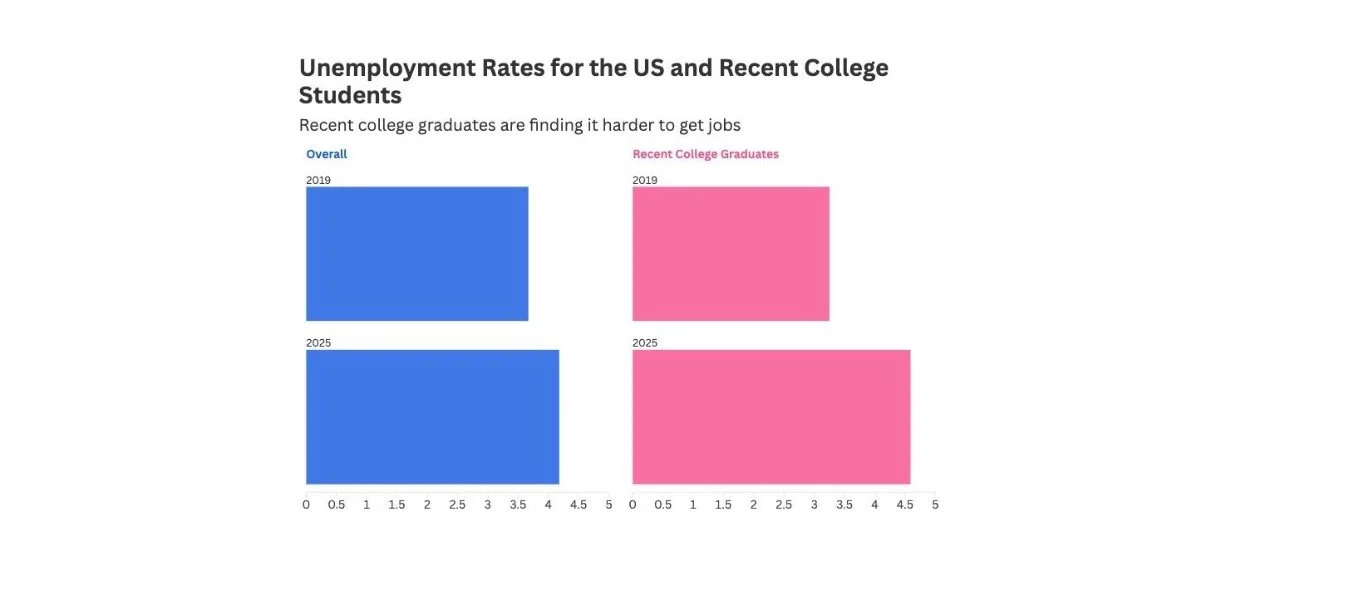
In the year of 2025, the job market hasn’t proved to be as plentiful as in years past. In the bar chart above, the US has experienced an increase in unemployment rates by 0.51 percentage points from 2019 to 2025. The unemployment rate for recent college graduates has grown significantly, with it being raised 1.31 percentage points from 2019 to 2025.
In a recent Reuters article, they point out the U.S. has hit a 4.3% unemployment rate. They also mention economists are blaming President Donald Trump’s policies for the slowed job market, one that has trickled down to recent college graduates.
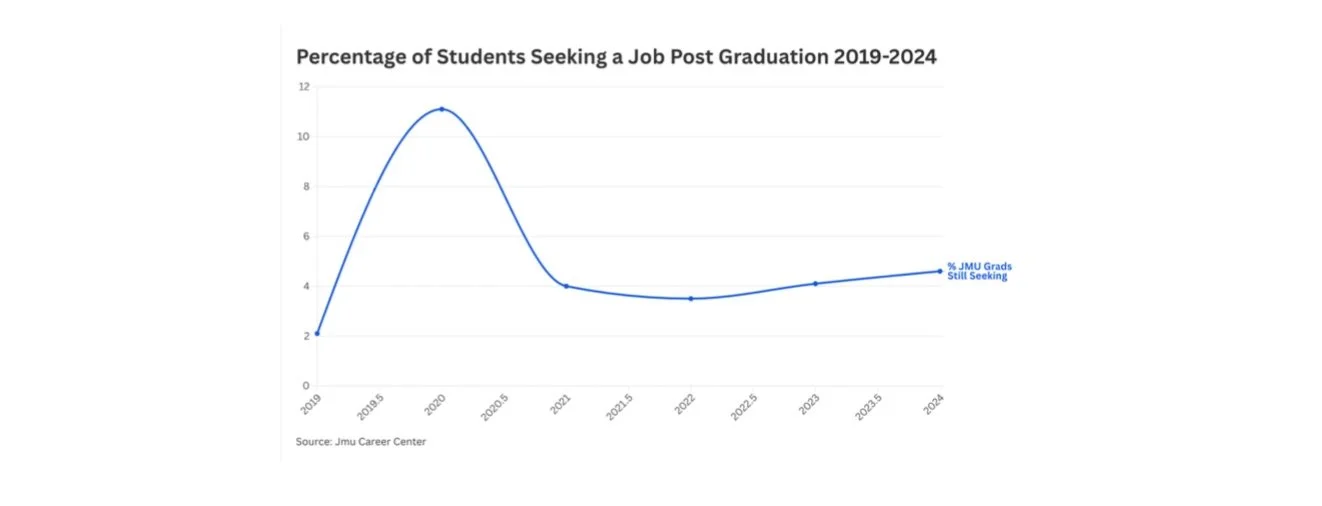
There are a number of factors that have contributed to this downward trend in college students still seeking jobs post-graduation, such as the COVID-19 pandemic, increase in artificial intelligence (AI) technologies and larger pools of competition.
Sam Squyars, the assistant director for career advising at JMU’s University Career Center (UCC), has been employed at the school for ten years and has watched student trends change
over time. Specifically, he notes COVID-19 created a shift in workplace environments, leading to competitive job hunts and changing what graduates expect to see in entry-level positions.
There’s been a downward trend for college graduates seeking jobs in the 2020s, JMU’s Career Center has resources to help
“I think COVID's impacted a lot of things where I think people are, I think one of the shifts that we saw right out of COVID was everyone wanted a remote job,” Squyars said. “And if someone wants 100% remote jobs, I think we're finding that those jobs can be the most competitive because a lot of people want that.”
This increasing shift toward wanting a technology-based remote job ties into workplaces now opting to use generative AI systems like ChatGPT instead of hiring real people. An article from the Wall Street Journal showed that the most recent graduates (starting with the class of 2023) are the most underemployed compared to past graduating classes.
Bill Balderaz, CEO of Futurety, is just one example of the trend toward AI that professionals are seeing today. Balderaz told the Wall Street Journal they didn’t hire an intern for the summer because they could use ChatGPT for the job instead, offering a quicker, and frankly cheaper, option to the paid employee.
As for the UCC, they don’t see AI as a replacement. Instead, it’s a tool — one that must be double checked and not blindly relied on. While AI is certainly a shift, as UCC Director Libby Westley said, it is something that students are learning and getting used to.
“I also think that in students' classes, they're learning about [AI]. They've had to reckon with this. The faculty are having to reckon. So students have more experience in this than some of the current working professionals,” Westley said. “You know AI can't do things the same way you did. It still needs to be cleared, checked, double checked.”
Westley and Squyars have seen AI firsthand when used for job applications. Young adults hunting for jobs, as well as companies looking for employees, incorporate AI within mass applying, reading and understanding job descriptions, and filtering applicants.
The UCC tells students to stop by their office to make sure they stand out in job applications and to find more than one way to apply for jobs. They recommend scouring the Internet for open listings while also networking in person to let companies get to know them for who they are, which is why consulting only AI can eliminate an applicant’s voice.
“It's not wrong to use AI in your materials, but it can't just be the stopping point in your materials,” Squyars said. “You still have to use your own language. You still need to stand out in the process. So I have seen AI go more wrong for students, at least in the searches that we have run than it has gone right for students.”
Although these factors are affecting students all over the country, the UCC has been providing countless resources to the students to assure a smooth transition from college to the job industry.
“We want to kind of weave career readiness throughout the whole place, whether it's getting students to think about their career ideas from the time they get here all the way through until they graduate,” Westley said.
The UCC implicates the career app Handshake into their curriculum, enabling students of all majors and colleges to access hundreds of job and internship listings, attend career fairs, career workshops and even employer events. Just last week, the UCC hosted a local employers networking lunch with the College of Science and Math, and the Friday of Homecoming they are hosting a networking reception for student alumni.
About 56% of students in 2024 utilized the UCC last year, and they are hoping for more involvement this year with the Career Center’s new programs and opportunities. Recently, the UCC created the “Ten Career Communities,” allowing students to organize their interests and communicate with specific employers in a less overwhelming manner. Additionally, the UCC is planning on hosting industry panels once a week and attending student’s lectures to promote their vision.
The purpose of these events isn’t just for students to walk away with a job, but rather build their skills to help them long term in the job industry. “If we can teach them these things while they're here, then when they leave, they'll have all the tools they need to continue to be able to make good career decisions,” Westley said. The goal for students, and really for all of us, is to create a network of people who know about you, me, and the opportunities that we're interested in.”
Although it has become statistically more difficult for recent college graduates to find jobs across the nation, JMU and the Career Center’s resources will help prepare students for this transition and utilize their skills in the work force.
Co-writers: Ashlee Thompson & Grayson Banning
10/25