The Freeze on Funding and Freedom
On June 28th, 2016, a family of six traveled over 6,000 miles with nothing but each other. They departed from Erbil, Iraq to Jordan, then Jordan to Frankfurt, Frankfurt to New York, and finally New York to the Shenandoah Valley Airport, where their old lives in Iraq would eventually fade. They left all behind including the children's father, who remained in Kurdistan to support the family from afar for an additional six years. All the family wanted was a home-cooked meal and a flat surface to sleep.
“There's always something in your mind about the next step when you say America, maybe the skyscrapers, busy streets...but ours is not for tourism, you want to go so you [can be] accepted...because you want safety...and education,” said Kurdish immigrant Ferwerdin Barzanji.
The Barzanjis were driven to an aged house in a hidden part of Harrisonburg. Old wooden floors and ancient scents filled the home, with no rugs to mask the smell. Their first meal in Harrisonburg was prepared by nonprofits, and although it was food the Barzanjis weren’t familiar with, their yawning mouths were hungry.
“It was the first supper we [had] there. Even [though] sometimes the food that people prepare is not [from] your culture, you are hungry...so it was a good meal for us and we felt very welcomed,” said Barzanji.
The food didn’t matter as much when their droopy eyes had discovered five mattresses just for them, a real place to sleep.
“The kids were asking when they can lay down on a bed, not an airplane chair...their bodies were aching...[seeing the beds] was a very good feeling and the most important thing for us at that time,” said Barzanji.
Aside from dinner and beds, information ranging from lists of colleges, hospitals, jobs and schools was provided for the family on their arrival, as well as $1,000 to get them started in this foreign country.
The Barzanji's journey of relocating to Harrisonburg, finding jobs, enrolling in schools and building a life for themselves in the US wouldn’t have been possible without the support of Harrisonburg’s local nonprofits, such as Church World Service and Skyline Literacy.
Currently, there are 845 organizations and 149 nonprofits in Harrisonburg and many of them serve families like the Barzanjis traveling to the U.S. According to USA Facts, in 2023, 1.16 million immigrants were reported living in Virginia, making up 13.4% of the state’s population.
However, new policy changes pose a threat to the success of these organizations and are therefore a threat to refugees coming to the United States. These programs rely on federal funds and grants to carry out their services, which they may soon lose permanently.
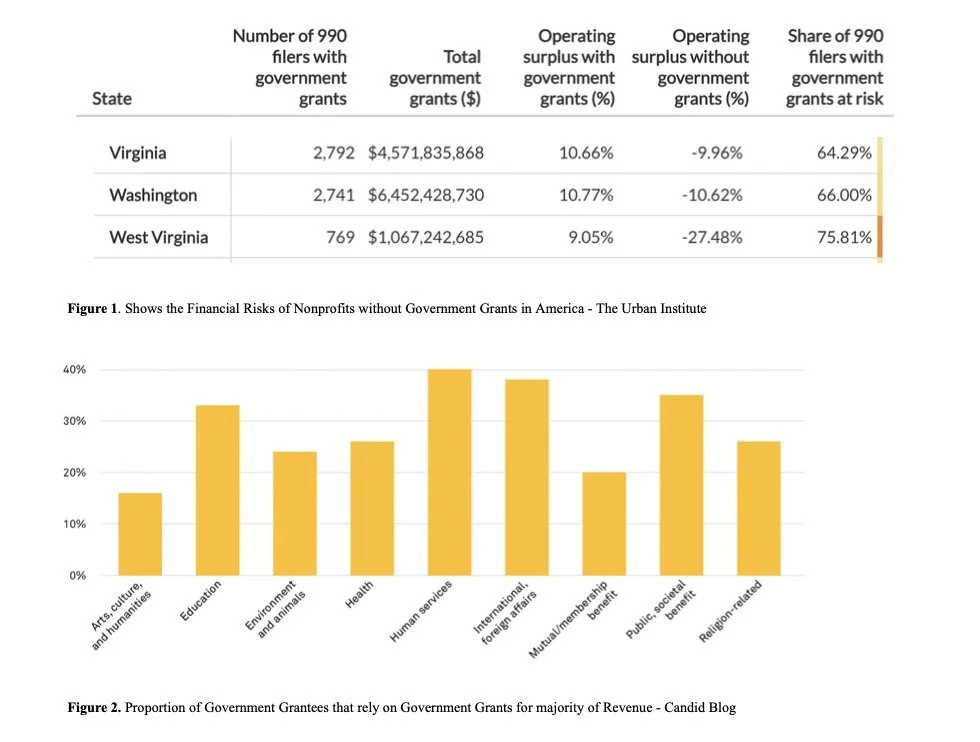
On January 28th, 2025, the Trump administration issued a freeze on all federal grant, loan and financial support programs. According to the Urban Institute, nonprofits receive $267 billion in government grants in the US. The loss of federal funds is detrimental to nonprofits around the country, with about 35,000 organizations nationally relying on government funding for over 50% of their operating income, according to the National Community Reinvestment Coalition.
The major disruption from the loss of funding has led organizations across the country to cut staff, positions, hours and programs to remain afloat.
“I don’t think people are aware of the tangible impacts of what’s happening,” said Lauren Jefferson, Director of Programs and Marketing for The Community Foundation in Harrisonburg. “There are people who have devoted careers and countless hours towards the mission of their nonprofit. They’re not in it to make money. They’re in it to serve and they’re passionate, and that’s being impacted hugely by this.”
***
CWS
Church World Service (CWS) is a national organization that is the heart of the Harrisonburg nonprofits. Their mission is to help new immigrants adjust to Harrisonburg and other areas across America, however, the loss of federal funding has made them unable to bring in new immigrants from unsafe situations.
Before the federal freeze, the government failed to reimburse CWS for months of work previously done. After the cuts, a USCIS Citizenship and Integration Grant meant to fund lawful immigration to the United States was terminated by the U.S. Department of Homeland Security. This grant was vital funding for the organization. Their financial circumstances have prevented them from assisting immigrants already living in Harrisonburg and have made them unable to bring in new refugees.
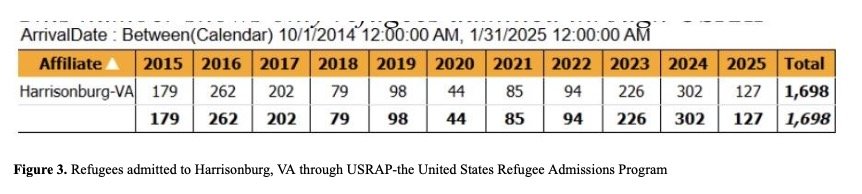
According to Church World Service’s 2024 incident report, there were 431 new immigrants in Harrisonburg. Out of those 431, 329 had job placements, 187 were enrolled in school, 216 had work permits and 411 possessed green cards, all supported by CWS. In the US, 9,000 refugees go through CWS every year, according to Rodrigue Makelele, Senior Community Organizer of Church World Service.
“Now there’s nobody coming, and nobody has come since January 20th,” said Susannah Lepley, the Virginia Director of Church World Services.
The loss of funding has also delayed some of CWS’ services that help the local refugees with everyday activities, such as tax forms and bills.
“[When] people are newcomers, they are blind,” said Barzanji. “They don't know what their bank account is...their insurance...They don't know how to set their medical record. They don't know how to call 911. CWS takes care of everything. But now they [can’t] take anybody new.”
The need for CWS’ services didn’t stop once the funding stream stopped, since 29 immigrants arrived in January a week before the freeze. Church World Service recognized the urgency of their services, and could only provide them by furloughing 75% of their local staff along with additional staff located in Africa helping with the resettlement process.
Additionally, CWS put some of their own private funding into their remaining programs, such as the Health and Human Services funding that goes through the Department of Social Services. CWS also received funding from The Great Community Give, an online donation day hosted by The Community Foundation, and received $4,775 in private donations in mid-April. Twelve local churches and James Madison University volunteer groups have also assisted them with helping the new locals adjust in Harrisonburg.
The help from the community has contributed greatly to CWS services, but the federal government cuts devastated the abilities of the organization. The loss of federal funding has led individuals expecting to come to be stuck in their unsafe countries with no backup plan, has separated families and has created a lack of trust in the community, Lepley said.
“I'm starting to hear things like...America is starting to become like home, where you couldn't say what you felt and you were afraid of the government,” said Lepley. “There's a lot of breaking of trust because things change so quickly and so erratically that people are finding it hard to trust information as well.”
***
Skyline Literacy
Skyline Literacy is a nonprofit that provides basic literacy instruction and citizenship classes for refugees and immigrants in the Harrisonburg and Rockingham County area. The organization uses grant money for civics and literacy packages that teach refugees information needed to pass the citizenship exam.
Skyline Literacy also got its USCIS Grant cut, resulting in the loss of their funding for the next two years. The program lost $239,000, which is about two-thirds of its funding, said Nelly Shenk, executive director of Skyline Literacy,
“I went outside my house and I screamed. I just screamed and screamed and screamed,” said Janet Loker, board member and secretary of Skyline Literacy. “People are going to die...It’s a bad time, I’m not sleeping.”
As a result of the cut, Skyline is getting 21% less funding than in previous years, reducing the number of students it can serve by half. Furthermore, it is unable to improve its services, such as adding a digital literacy component, training new tutors and opening more classes. Without these resources, immigrants' future success in America will be largely affected, said Loker.
“When immigrants come to this country, the first thing they need is English and to know they belong here,” said Loker. “They're coming from countries that have been harassed, so they come here hungry and without money. They need to be here and learn our culture and language quickly.”
Juan Escobar Franco, an immigrant from Paraguay, South America, studies with Skyline and attends English classes every Monday and Thursday.
“There's a lot of people that come in from everywhere and [there’s] always somebody [who] needs help,” Franco said. “Skyline is right there. They are open for everybody, no matter if you're black or white or whatever, they [are] always there to help people.”
The loss of funds has made Skyline Literacy unable to pay for their employee’s health care, train new tutors, hire teachers and reach out to permanent residents, resulting in refugees not getting the proper help they need transitioning to this country.
To combat the loss, Skyline is applying for numerous grants to fund its needed services to refugees, as well as asking the community for additional help. Skyline set its donation goal to $25,000 during The Great Community Give and raised $33,407.
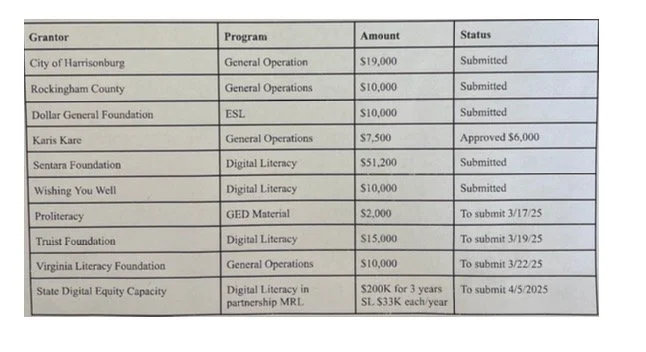
Figure 4. Skyline Literacy Grants applied for in 2025
***
Ferwerdin Barzanji has a PhD in Clinical Biochemistry, is a member of the Welcome Committee, school liaison for the Harrisonburg public schools and interpreter for CWS. Her husband has a PhD in business and was president of a foreign university. Her oldest is an engineer in cyber security. Her second graduated in neuroscience and works at a sleep center. The third graduates May 17th as a JMU biologist and is planning on taking the MCAT to become a doctor. Her 4th is studying kinesiology at UVA and her last attends JMU and is considering becoming a veterinarian.
They are all also refugees from Kurdistan, Iraq.
The Barzanji’s success was possible due to the work of Harrisonburg’s local nonprofits. The federal cuts have impacted these organizations significantly, but their dedication to the refugee community will remain regardless of the support from the government.
“I just feel like it's our job as humans to help other humans,” said Ashley Gordon-Becker, executive director of Way To Go, a nonprofit centered around providing transportation services. “It doesn't mean that we're paying their bills necessarily for them. We can provide something like a vaccination or food to a child in another country that needs it to survive...If you really look at the numbers and look at things, it's not as big of an impact as they're saying it is. But to me, it's a human life. So it is.”
4/25